
Quality & cupping
Cupping sessions: the step no buyer skips
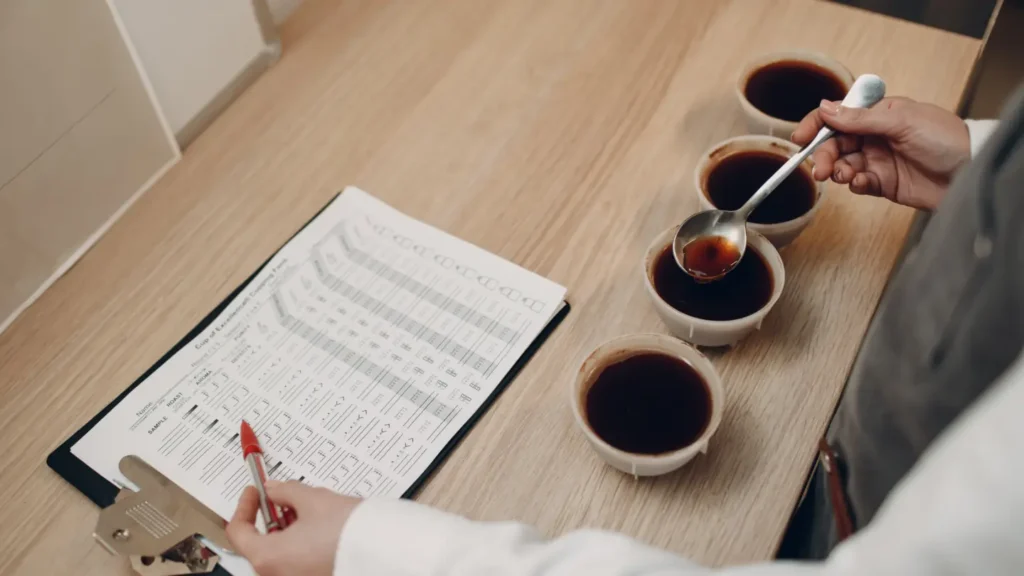
Before any lot of green coffee reaches a roaster’s warehouse, it goes through a step that can neither be skipped nor taken lightly: the professional cupping session.
Cupping, as it is known in the coffee industry, is the standard method buyers and roasters use to assess the quality of coffee before buying it. It is not a casual taste of a cup of coffee, but a controlled procedure repeated with the same steps every time, so that results can be compared from one lot to another and from one season to the next.
The session starts by roasting a small sample of the green coffee to a light, even roast that shows the character of the bean itself rather than the roast. The sample is then ground and placed in identical cups at a fixed ratio of coffee to water, and its dry fragrance is assessed before hot water is poured over it.
Once the water is poured, a layer of coffee called the “crust” forms on the surface of each cup. After a few minutes the crust is broken with a spoon, releasing the trapped aroma all at once — the moment when the taster assesses the aroma. The foam is then removed and the cup is left to cool a little before tasting begins.
The coffee is tasted from the spoon with a quick, strong slurp that spreads it across the whole mouth, and tasted again several times as the temperature drops, because some qualities only appear as the cup cools. The taster scores specific attributes: fragrance, flavour, aftertaste, acidity, body, balance, sweetness, clean cup and uniformity.
These scores add up to a total out of 100. Coffee that scores 80 or more is classed as specialty. Our lots fall into two ranges, 82 to 84 and 85 to 88, and each range is a separate lot with its own code.
That is why a professional buyer usually asks for two samples: a pre-shipment sample on which the purchase is decided, and an arrival sample that confirms that what arrived is what was cupped. Comparing the two sessions is the practical guarantee that the lot did not change on the way.
At Mocha Heritage we see the cupping session as the start of our relationship with a roaster, not an obstacle to it. Any roaster can request a sample of the lot that interests them from the sample request page, and compare its own assessment with what we state on the lot page.