
Opens in a new tab
Skip to content

873 farmers, 781.5 hectares

Behind every bag that leaves Yemen is a person who worked hard mountain land by hand — land inherited from a father and a grandfather. We draw on our knowledge of Yemen’s coffee-growing regions and our relationships with trusted local farmers and suppliers.

This page shows who they are, how they farm, how they harvest, and how they dry and process the crop.

Producers in numbers

RegionFarmersHectaresFamiliesTrees/ha
Khawlan Bani Amer2221872632,000
Haraz1411121001,000
Ibb — Al-Qafr1311001221,500
Bani Matar9868.5811,000–5,000
Haymah97100—700–1,000
Total873781.5736—

The total above is for our six regions as recorded in our farm data, and includes the sixth region, in Taiz governorate, whose details will be added later. It is the figure used on the home page and across the site.

Smallholders, not estates

The vast majority of Yemen’s coffee farmers are smallholders, working small plots inherited over generations, where coffee is usually part of a wider farming system that includes fruit and grain. The average holding in our regions is between 1,000 and 1,200 trees.

We work with local suppliers and processing partners in Yemen to select coffee crops by quality standards and origin characteristics, with close attention to processing, drying, hulling, sorting and export preparation, to meet the needs of specialty roasters and international importers. It is also an extension of the value the company was built on: trust and mutual respect with those who work the land.

How the coffee is grown

Traditional, chemical-free farming

Farmers in these regions use no synthetic fertilisers and no chemical pesticides. The soil is fed with manure and leaves from nearby woodland trees — acacia in Bani Matar, mango in Al-Qafr. Pest control is traditional: smoke from dry ficus wood, and plant-based sprays.
Shade trees

Coffee grows beneath larger trees, often local fruit trees, which protect it from direct sun and support the biodiversity that keeps the soil healthy. Shade ranges from 10% in Bani Matar to 70% in Al-Qafr.

Mountain terraces

Hand-built stone terraces are the backbone of farming on steep slopes — inherited engineering that stops soil erosion and makes unusable slopes workable.

Water

Rain, springs, wells and floodwater, topped up in some districts with water carried by caravan. Rainfall in our regions ranges from 200 mm in Bani Matar to 800 mm in Al-Qafr.

Harvest

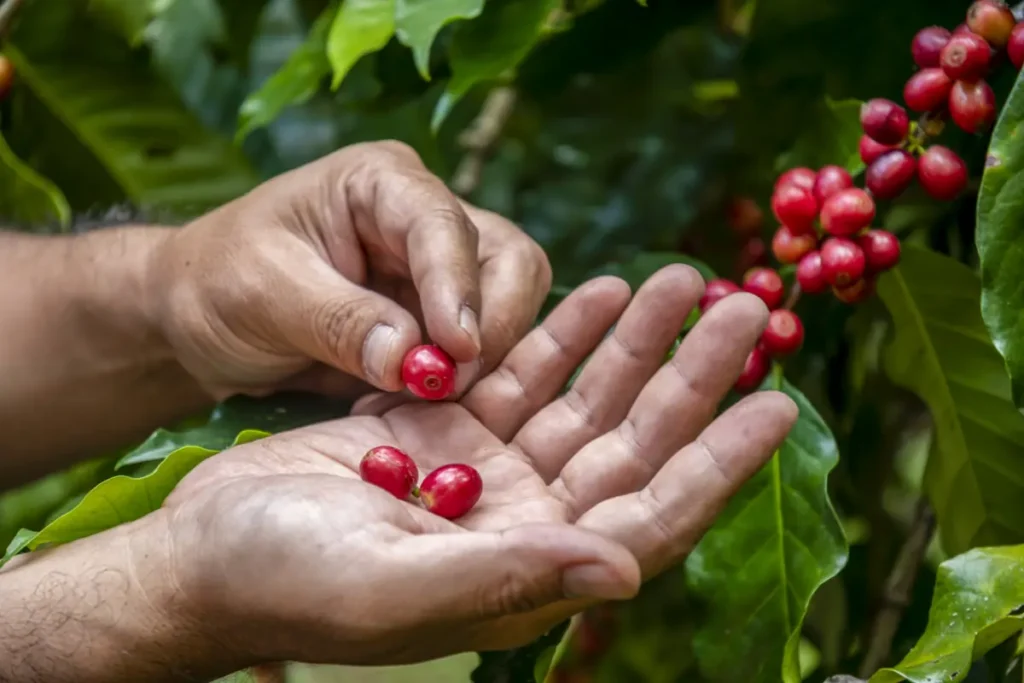
The entire harvest is selective hand-picking: the farmer takes only the ripe cherries, one by one — no strip-picking and no machine harvesting. It costs more time and labour, and it is the clearest single factor in cup quality.

The main season runs from October to March in all our regions.

A farmer's hands picking ripe red coffee cherries from the branch
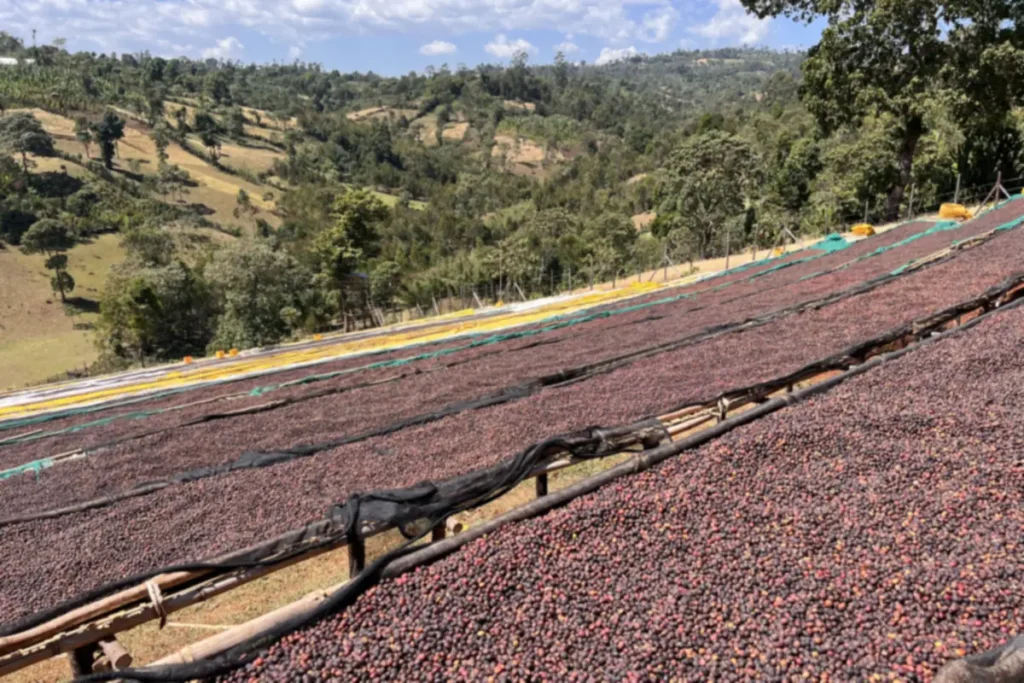
Coffee cherries drying in the sun on raised beds, with green hills behind

Drying

The cherries are sun-dried — the traditional method in Yemen, made possible by strong sun and low humidity in the mountains. They are spread on rooftops and raised beds and turned regularly, so that drying is even and spoilage does not start.

The process takes from days to weeks depending on conditions, and needs daily attention to reach the target moisture level without going past it.

Processing

Natural processing is the main method in our regions: the whole cherry, with its skin and pulp, is dried in the sun before hulling. It is the method historically responsible for the intensity and complexity that set Yemeni coffee apart.

Two regions — Haraz and Haymah — also produce anaerobic coffee. Wherever a method other than natural processing is used, it is stated on the coffee’s page.

Browse our coffees

A heritage of trust, and a present built on documented quality. Start your partnership with Mocha Heritage.